
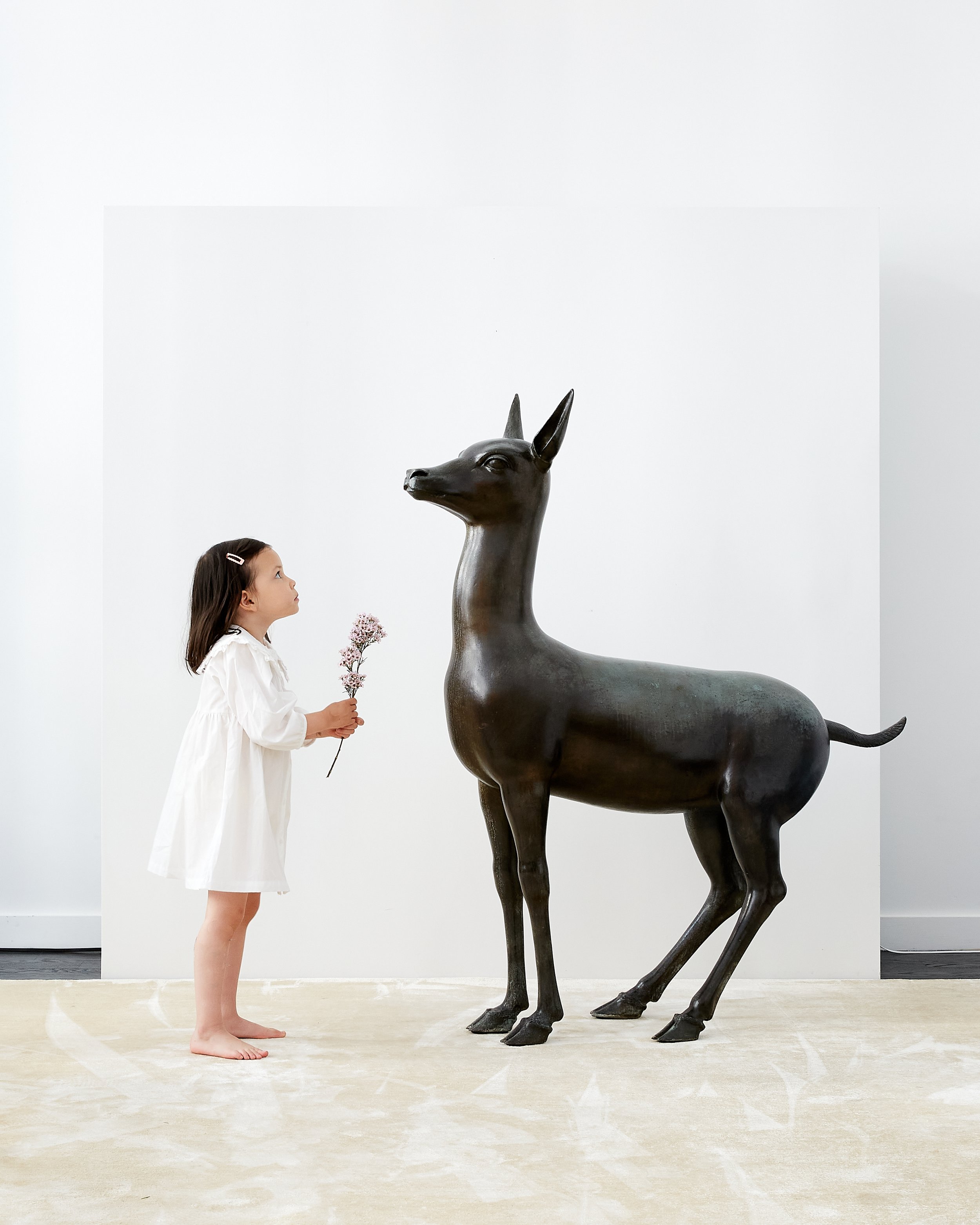
Frederic Mares Deulovol (1893-1991) patinated bronze gazelle doe.
Base signed in the casting: F. Mares; with impressed foundry mark: Fundicion R. Vila / Valls (Tarragona).
Bronze base has been removed for photography and because we feel the doe stands more beautifully in a room without it, though it could be simply placed back on matching bronze base if desired.
This doe comes form a California estate where it was kept outdoors, partially covered. The resulting patina and verdigris is beautiful and reminiscent of a Pat Steir painting. The bronze is beautifully sculpted with incredible, life-like details, from the slight movement of the tail to the deep gaze of the eyes.
Measurements: 52" H x 46" W x 11.5" D
Shipping + Delivery: Free local (NY) delivery. We also ship nationwide and worldwide. Please contact us for shipping or delivery costs. We work to obtain the most affordable shipping rates possible while ensuring that pieces are delivered safely.

Charlotte Perriand Ash Coffee Table
France c. 1956
Solid ash.
Measurements: 13.5" height x 55" length x 20.25" depth
Shipping + Delivery: Free local (NY) delivery. We also ship nationwide and worldwide. Please contact us for shipping or delivery costs. We work to obtain the most affordable shipping rates possible while ensuring that pieces are delivered safely.
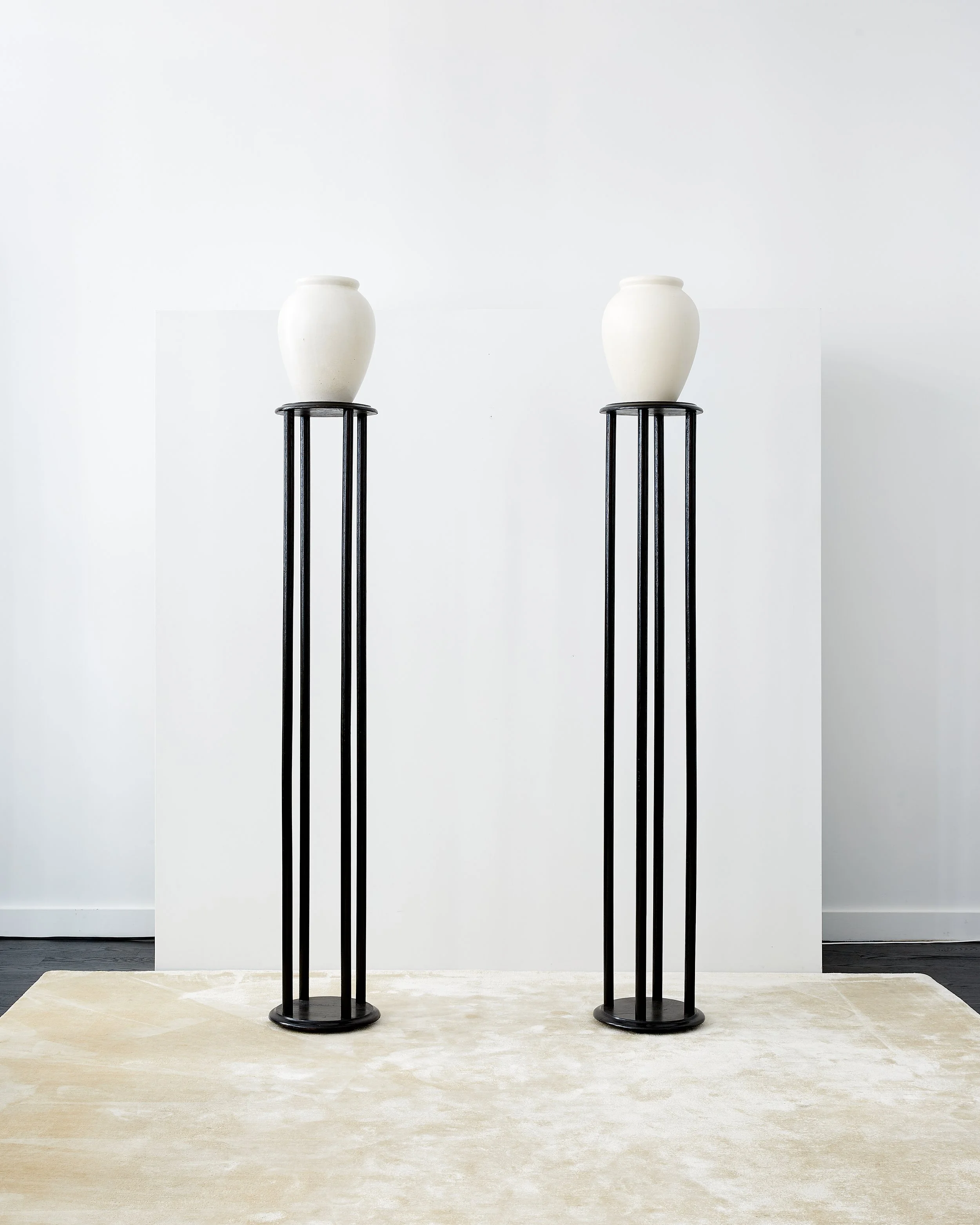
Pair of Josef Hoffman Display Pedestals.
Austria c. 1910 - 1919.
Stained Beech.
These rare, exaggerated pedestals originated from the Villa Pick, a Jewish villa located in Prague built in 1931 by the architect Arnošt Wiesner. They originally sat alongside a set of Thonet no. 811 ‘Prague Chairs’.
Measurements: 59.5” height, 11” diameter of base, 10” diameter of top
Shipping + Delivery: Free local (NY) delivery. We also ship nationwide and worldwide. Please contact us for shipping or delivery costs. We work to obtain the most affordable shipping rates possible while ensuring that pieces are delivered safely.
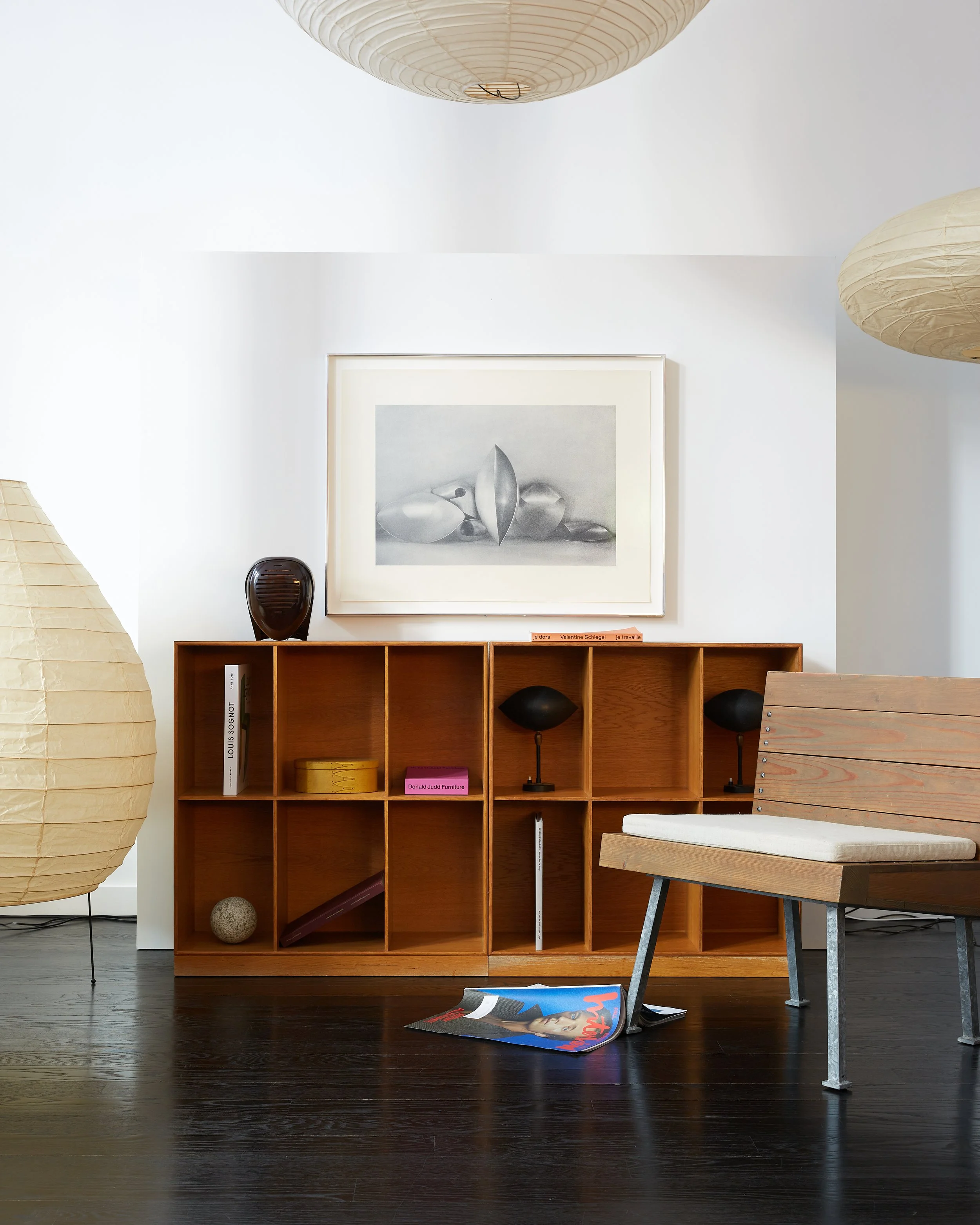
Mogens Koch solid oak modular bookcases by Rud Rasmussen.
Denmark c. 1950s.
Three units available. Priced individually.
Measurements: Each unit measures 30” width, 11” depth, 30” height (32” height with plinth)
Shipping + Delivery: Free local (NY) delivery. We also ship nationwide and worldwide. Please contact us for shipping or delivery costs. We work to obtain the most affordable shipping rates possible while ensuring that pieces are delivered safely.
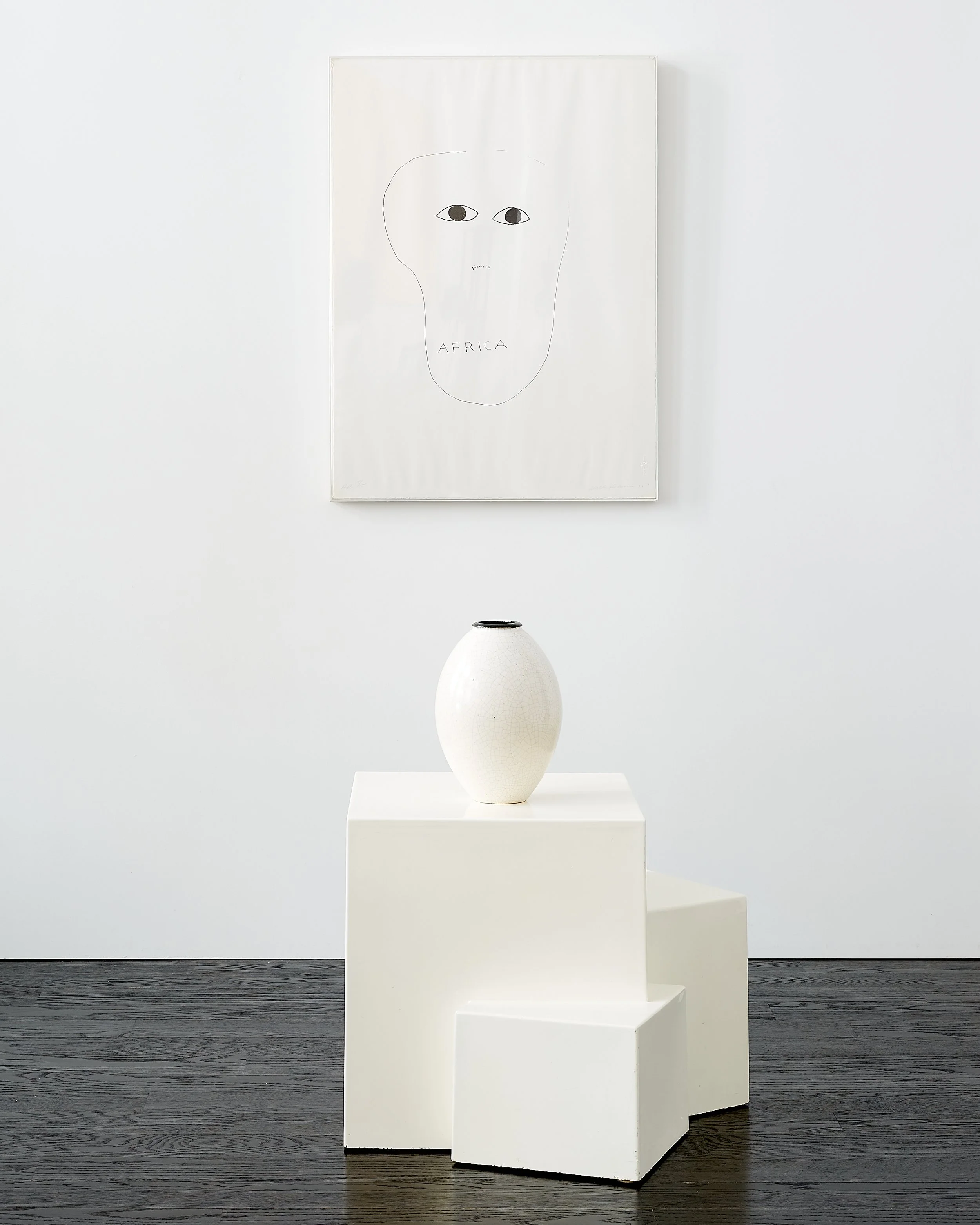
Philippe Cheverny Ivory Lacquer Cube Side Table.
France c. 1970.
Lacquered perspex.
Measurements: 17.75” height, 25.5” width, 22” depth
Shipping + Delivery: Free local (NY) delivery. We also ship nationwide and worldwide. Please contact us for shipping or delivery costs. We work to obtain the most affordable shipping rates possible while ensuring that pieces are delivered safely.
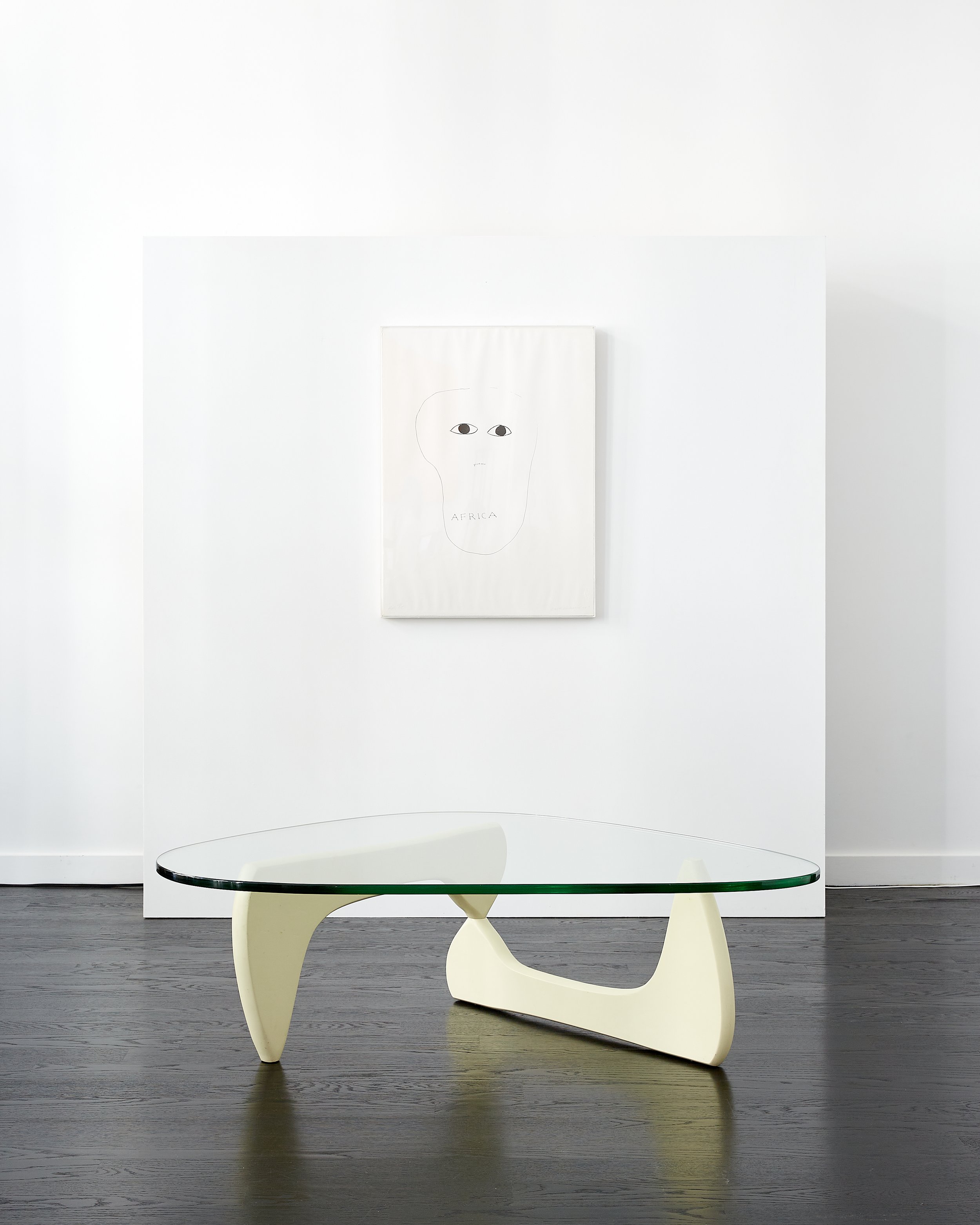
First Edition Isamu Noguchi IN-50 Coffee Table c. 1964.
Original green edge glass top in excellent condition. No chips. Light scratches and signs of wear commensurate with age.
Wood base professionally painted ivory in 1964 when the piece was ordered by first owners. Original invoice provided (please refer to last image).
We’ve always hesitated about buying this piece but when we found this incredible version in ivory paint that has been gathering patina since the 1960s and has remained in one family since purchase, we fell for it. The table is an extraordinary harmony of form and function and this version feels very special.
Measurements: 44” length, 43.5” width, 15.75” height
Shipping + Delivery: Free local (NY) delivery. We also ship nationwide and worldwide. Please contact us for shipping or delivery costs. We work to obtain the most affordable shipping rates possible while ensuring that pieces are delivered safely.
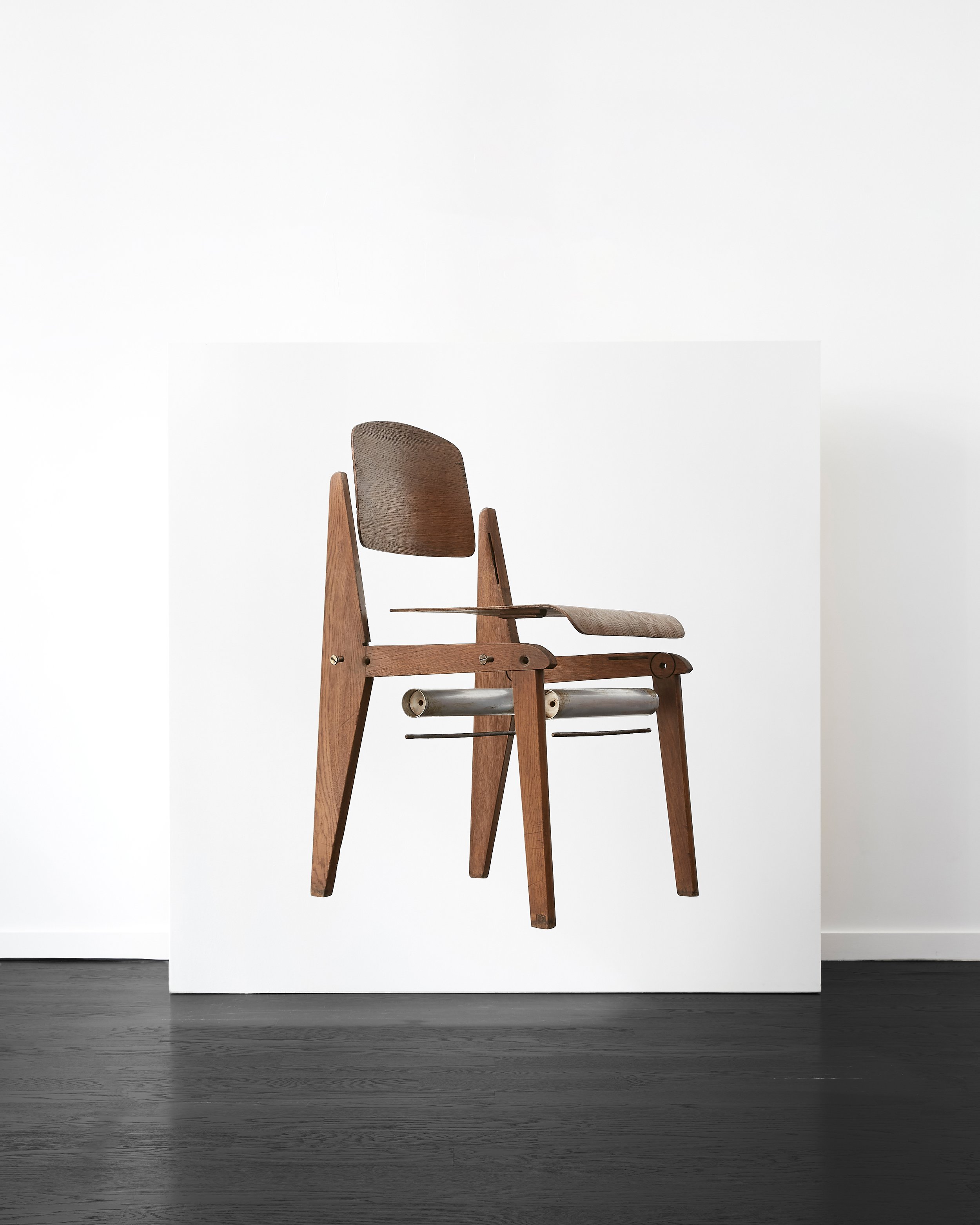
Jean Prouve 'Demountable' Wood Chair Model CB 22 c. 1950.
Designed in 1947 and manufactured by Atelier Jean Prouvé until the studio’s closure in 1953.
Solid wood, molded plywood, aluminum.
The CB 22 chair is historically significant in that it underscores Prouvé’s ability to adapt and innovate, using wood at a juncture when materials such as steel were in short supply.
It comprises two solid wood lateral bases held together by two braces bolted on the outside. The back and seat were initially fixed to the frame with screws, then with tapped studs, while the tubes protecting the braces are made of metal. The first “do-it-yourself” chair, it was shown disassembled on the cover of the Ateliers Jean Prouvé furniture catalogue in 1951.
Measurements: 31.5" height, 16.5" width, 18.5" depth, 18" seat height
Literature:
Jean Prouvé, Complete Work Volume 3 (1944- 1954), P. Sulzer, Birkhaüser, 2005, model referenced and illustrated at no. 1134.1, 2
Jean Prouvé, L. and P. Seguin, Galerie Patrick Seguin, 2017, similar model and archive photographs of the model pp.72- 73
Jean Prouvé, Constructive Imagination, Galerie Patrick Seguin / Museum of Contemporary Art Tokyo, Millegraph, similar model p.72-73
Le Décor d’Aujourd’hui, no 52, 1949, similar models pp.24-25 in a view of an apartment in the Cité Radieuse of Marseille
Shipping + Delivery: Free local (NY) delivery. We also ship nationwide and worldwide. Please contact us for shipping or delivery costs. We work to obtain the most affordable shipping rates possible while ensuring that pieces are delivered safely.

Price on Request.
Le Corbusier and Pierre Jeanneret committee table.
Chandigarh, India. c. 1963-1964
Rare model with solid teak top
This is an early example from Punjabi University, Patiala, where these tables were first made. They were later made for Chandigarh.
Most of these tables have a veneer top, this example is comprised of solid teak boards. The underside of the table top is hand planed with chiseled v-shaped cut outs so that the boards can be held together more securely. The top boards are diagonally matched so as to maximize use of wood.
Measurements: 46 1/2” width, 97 1/2” length, 30 1/4” height
Shipping + Delivery: Free local (NY) delivery. We also ship nationwide and worldwide. Please contact us for shipping or delivery costs. We work to obtain the most affordable shipping rates possible while ensuring that pieces are delivered safely.

André Chetaille four-door cabinet in ash sitting on elliptical legs.
France c. 1965.
Handles are tapered turned ash and interior with five adjustable shelves and two drawers.
André Chetaille (1906-1978) was Perriand’s master cabinet maker. Pictured in the last image is Paul Chetaille, André’s brother, in front of three slabs of wood to be used for Perriand’s wood furniture.
Provenance: Succession X., Mantes-la-Ville. Bought by the decorator M.C. Guérin for his client to accompany an important furniture set by Charlotte Perriand.
Measurements: 89.5" Length, 34.25" Height, 21.5" Depth
Shipping + Delivery: Free local (NY) delivery. We also ship nationwide and worldwide. Please contact us for shipping or delivery costs. We work to obtain the most affordable shipping rates possible while ensuring that pieces are delivered safely.

Dom Hans van der Laan unique desk with copy of original drawings.
From a private doctor’s practice, Sint-Michielsgestel, the Netherlands c. 1970.
Spruce, copper nails, paint.
Color is 60.05.Y50R from van Der Laan’s highly selective color palette of eight shades, which he developed alongside Dutch artist, Wim van Hooff (1918 - 2002), one of the leading and most outspoken color consultants of the second half of the twentieth century.
The Doctor’s practice was designed in the Bossche School style by Vermeulen Architects in Veldhoven, the Netherlands. It is extremely rare, if not unique, to have a piece together with the original drawings. Materials and techniques are specified on the drawings: “First class selected spruce…Bone-dry processed - planed…Everything pre-stained…Connections cross pin and copper rivets”
*Matching stool available.
Dimensions: 45” width, 39.25” depth, 30” height.
About Dom Hans van der Laan (1904 - 1991):
Dutch Benedictine monk, architect, and leading figure of the Bossche School, Dom Hans van der Laan developed a new vision for architecture from within the confines of the monastery, completely uninfluenced by discussions in the world of architecture and design.
Not perceiving the golden ratio to be relevant to the field, van der Laan developed a theory of the ‘plastic number’, which he developed over decades by methodically studying the rhythms, rules and proportions found in nature. The mathematics of beauty.
Approached from a philosophical, theological and technological perspective, his architecture and furniture examines the primeval origin of architectural principles and the fundamental essence of the form. On both a theoretical and practical level, van der Laan sought to give significance and importance to simplicity. A voice to silence, a form to the void.
If van der Laan’s innovative work is characterized by an all embracing simplicity, numbers are the only decoration present. These numbers govern all formal choices and establish a relationship between the parts but, once used, disappear without a trace, leaving only the invisible harmony that permeates.
Additional information on the work of Dom Hans van der Laan can be found here.
Shipping + Delivery: Shipping costs are not included in the sale price as they vary greatly depending on location. Please contact us for shipping or delivery costs. Local (NY) delivery and pick-up is available, we also ship nationwide and worldwide. We work to obtain the most affordable shipping rates possible while ensuring that pieces are delivered safely.

Shaker trestle dining table c. 1830.
Pine and cherry.
Harvard, MA community.
Early repair to base dating to early 20th century.
Provenance: Adelaide and Ted de Menil (last image is of Ted de Menil using the table in his office)
Measurements: 28.75” height, 84.25” length, 33.75” width
Shipping + Delivery: Free local (NY) delivery. We also ship nationwide and worldwide. Please contact us for shipping or delivery costs. We work to obtain the most affordable shipping rates possible while ensuring that pieces are delivered safely.
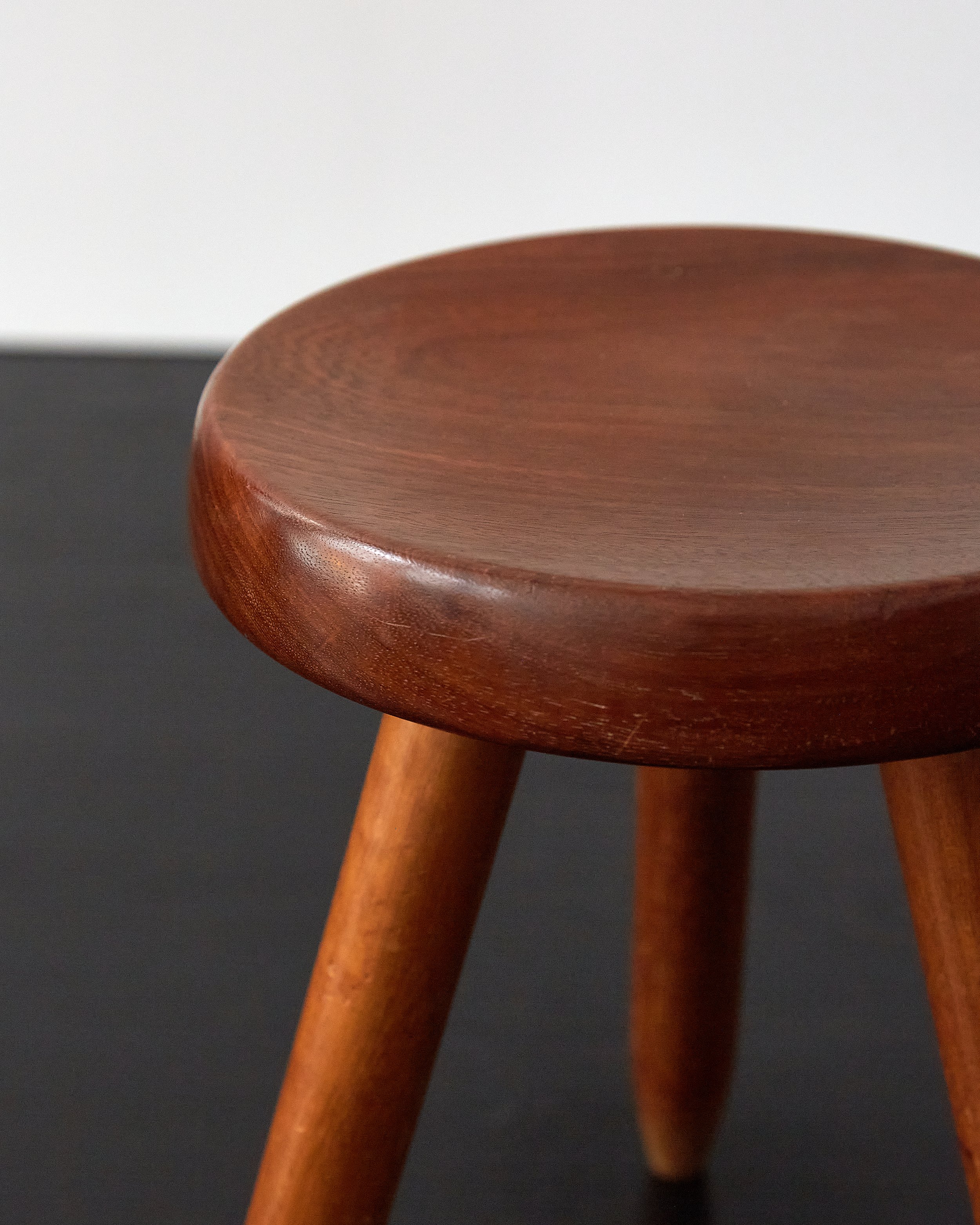
Charlotte Perriand high Berger stool in Mahogany.
Steph Simon Edition.
From the home of Claude Parent (the last images are of the stool as originally situated and used within his home).
Literature:
Jacques Barsac, Charlotte Perriand - L'oeuvre complète - Volume 2. 1940-1955, Éditions Norma, Paris, 2013, modèle référencé et reproduit p. 4582
Measurements: 17.75" height, 12.75" diameter
Shipping + Delivery: Shipping costs are not included in the sale price as they vary greatly depending on location. Please contact us for shipping or delivery costs. Local (NY) delivery and pick-up is available, we also ship nationwide and worldwide. We work to obtain the most affordable shipping rates possible while ensuring that pieces are delivered safely.

Pair of Charlotte Perriand Orcières stools with original black paint.
France c. 1960.
Measurements: 16.24" height, 12.5" width, 12.5" depth
Shipping + Delivery: Free local (NY) delivery. We also ship nationwide and worldwide. Please contact us for shipping or delivery costs. We work to obtain the most affordable shipping rates possible while ensuring that pieces are delivered safely.

Dom Hans van der Laan unique oak high back bench.
Commissioned for Willibrordkerk (St Willibrord’s Church), Almelo.
The Netherlands c. 1960’s.
Van der Laan rarely used oak in his furniture. This unique piece is also without the copper nails typical of his work.
Willibrordkerk Almelo was designed by Jan de Jong according to the Plastic Number and the ideas of Dom Hans van der Laan.
Despite being one of the best examples of Dutch churches of the modernist era the church was knocked down in 2005 as part of a series of unfortunate closures. Two large friezes by Igor Strawinsky (1907 - 1989), son of composer, Igor Strawinsky, were preserved intact. A deep friendship had developed between Strawinsky and van der Laan, who highly valued sacred art.
Dimensions: 67” length, 25.25” depth, 44.25” height, 16” seat height
About Dom Hans van der Laan (1904 - 1991):
Dutch Benedictine monk, architect, and leading figure of the Bossche School, Dom Hans van der Laan developed a new vision for architecture from within the confines of the monastery, completely uninfluenced by discussions in the world of architecture and design.
Not perceiving the golden ratio to be relevant to the field, van der Laan developed a theory of the ‘plastic number’, which he developed over decades by methodically studying the rhythms, rules and proportions found in nature. The mathematics of beauty.
Approached from a philosophical, theological and technological perspective, his architecture and furniture examines the primeval origin of architectural principles and the fundamental essence of the form. On both a theoretical and practical level, van der Laan sought to give significance and importance to simplicity. A voice to silence, a form to the void.
If van der Laan’s innovative work is characterized by an all embracing simplicity, numbers are the only decoration present. These numbers govern all formal choices and establish a relationship between the parts but, once used, disappear without a trace, leaving only the invisible harmony that permeates.
Additional information on the work of Dom Hans van der Laan can be found here.
Shipping + Delivery: Shipping costs are not included in the sale price as they vary greatly depending on location. Please contact us for shipping or delivery costs. Local (NY) delivery and pick-up is available, we also ship nationwide and worldwide. We work to obtain the most affordable shipping rates possible while ensuring that pieces are delivered safely.

Dom Hans van der Laan chair with Open Arms for Raadhuis Budel.
The Netherlands c. 1962-66.
Ash, copper nails, black enameled steel legs.
Raadhuis Budel (Budel Town Hall) was designed in 1962 according to the principles of the Plastic Number by Dom Hans van der Laan. Jan de Jong was the architect for the project, which was completed in 1966. The building still exists however it was completely renovated in 1997. Much of the furniture was destroyed, though a few residents of Budel saved pieces from the containers they were removed in.
Dimensions: 24.25” width, 20” depth, 42” height, 19” seat height
About Dom Hans van der Laan (1904 - 1991):
Dutch Benedictine monk, architect, and leading figure of the Bossche School, Dom Hans van der Laan developed a new vision for architecture from within the confines of the monastery, completely uninfluenced by discussions in the world of architecture and design.
Not perceiving the golden ratio to be relevant to the field, van der Laan developed a theory of the ‘plastic number’, which he developed over decades by methodically studying the rhythms, rules and proportions found in nature. The mathematics of beauty.
Approached from a philosophical, theological and technological perspective, his architecture and furniture examines the primeval origin of architectural principles and the fundamental essence of the form. On both a theoretical and practical level, van der Laan sought to give significance and importance to simplicity. A voice to silence, a form to the void.
If van der Laan’s innovative work is characterized by an all embracing simplicity, numbers are the only decoration present. These numbers govern all formal choices and establish a relationship between the parts but, once used, disappear without a trace, leaving only the invisible harmony that permeates.
Additional information on the work of Dom Hans van der Laan can be found here.
Shipping + Delivery: Shipping costs are not included in the sale price as they vary greatly depending on location. Please contact us for shipping or delivery costs. Local (NY) delivery and pick-up is available, we also ship nationwide and worldwide. We work to obtain the most affordable shipping rates possible while ensuring that pieces are delivered safely.

Ethiopian Carved Wood Chair c. 1930’s-1940’s.
We were drawn to this chair by its sharp lines and fine quality of chip carving, as well as its curule shaped legs.
It is slightly larger in size than many Ethiopian carved wood chairs which makes it both functional as well as sculptural.
There is a discreet, old repair on the seat which is fully stable.
Measurements: 30.5” height, 17.75” width, 22” depth, 16” seat height
Shipping + Delivery: Free local (NY) delivery. We also ship nationwide and worldwide. Please contact us for shipping or delivery costs. We work to obtain the most affordable shipping rates possible while ensuring that pieces are delivered safely.
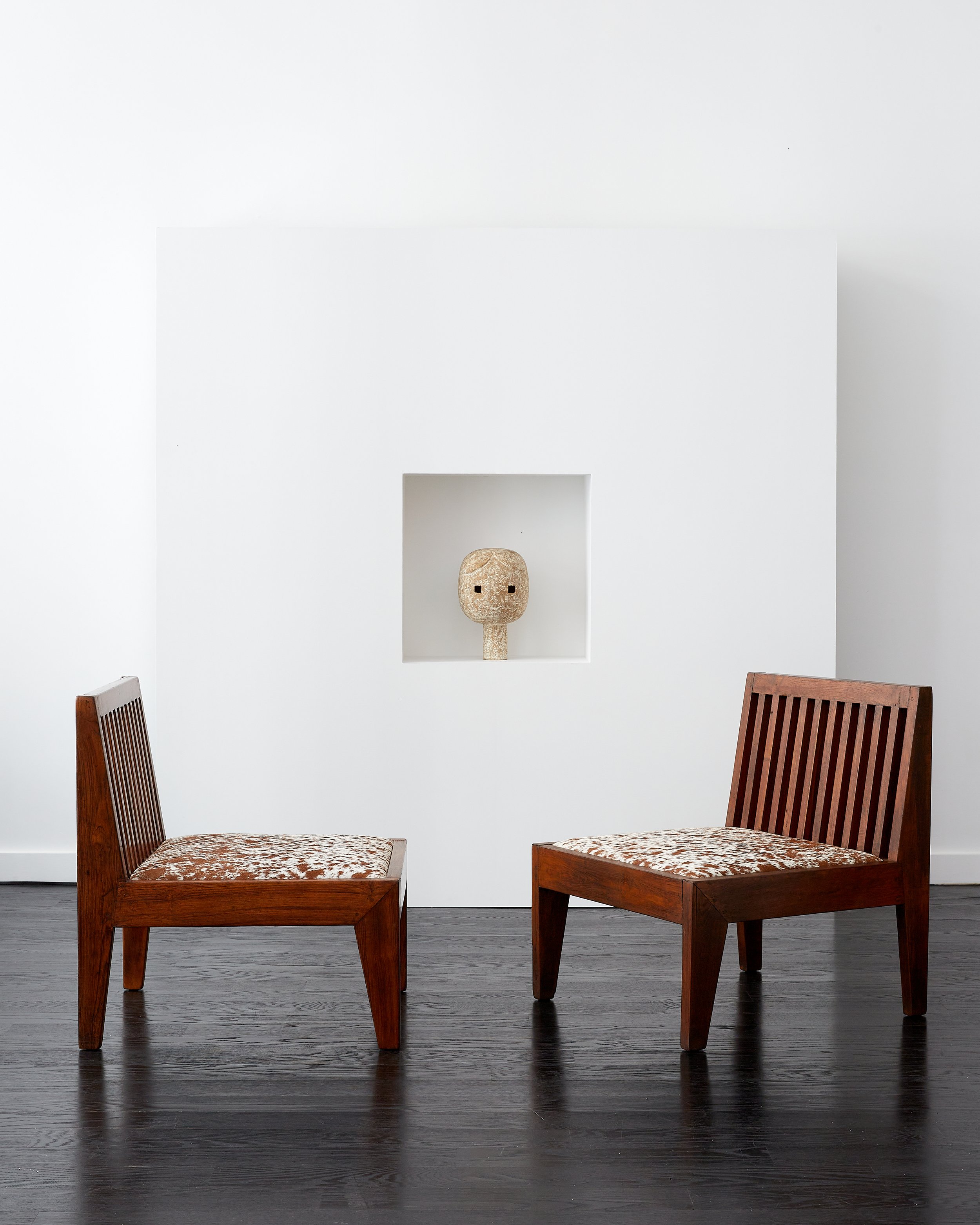
Pair of Pierre Jeanneret armless easy ‘Fireside’ chairs, model PJ-SI-18-A.
Private residences and PGI Institute, Chandigarh, India c. 1955 - 1960.
Solid teak.
Lightly conserved and upholstered by M.S., NYC.
Measurements: 22.5" width, 24.75" depth, 27.25" height, 13.25" seat height
Shipping + Delivery: Free local (NY) delivery. We also ship nationwide and worldwide. Please contact us for shipping or delivery costs. We work to obtain the most affordable shipping rates possible while ensuring that pieces are delivered safely.

Dom Hans van der Laan very rare pair of low chairs with galvanized steel legs.
The Netherlands c. 1967
Most likely made to furnish a project by Jan de Jong.
Pine, galvanized steel.
Low chairs like these are amongst the rarest of all the Dom Hans van der Laan furniture that has appeared on the market.
Dimensions: 25.25” width, 22” depth, 29.5” height, 16.75” seat height
About Dom Hans van der Laan (1904 - 1991):
Dutch Benedictine monk, architect, and leading figure of the Bossche School, Dom Hans van der Laan developed a new vision for architecture from within the confines of the monastery, completely uninfluenced by discussions in the world of architecture and design.
Not perceiving the golden ratio to be relevant to the field, van der Laan developed a theory of the ‘plastic number’, which he developed over decades by methodically studying the rhythms, rules and proportions found in nature. The mathematics of beauty.
Approached from a philosophical, theological and technological perspective, his architecture and furniture examines the primeval origin of architectural principles and the fundamental essence of the form. On both a theoretical and practical level, van der Laan sought to give significance and importance to simplicity. A voice to silence, a form to the void.
If van der Laan’s innovative work is characterized by an all embracing simplicity, numbers are the only decoration present. These numbers govern all formal choices and establish a relationship between the parts but, once used, disappear without a trace, leaving only the invisible harmony that permeates.
Additional information on the work of Dom Hans van der Laan can be found here.
Shipping + Delivery: Shipping costs are not included in the sale price as they vary greatly depending on location. Please contact us for shipping or delivery costs. Local (NY) delivery and pick-up is available, we also ship nationwide and worldwide. We work to obtain the most affordable shipping rates possible while ensuring that pieces are delivered safely.

Charlotte Perriand Tripod Chair in Ash.
Designed 1947 for l'Equipment de la Maison.
Manufactured by B.C.B, France.
Provenance:
Sotheby's Paris, May 24, 2002
Michael Maharam Collection, Sotheby's New York
Measurements: 26.5" Height, 13 7/8" Diameter, 16” Seat Height
Literature: Bibliography: Catalogue of BCB, 1952 – Furniture Charlotte Perriand & Pierre Jeanneret
Jacques Barsac, Charlotte Perriand – Complete Works – Volume 2 – 1940-1955, édition Archives Charlotte Perriand & Éditions Norma, Paris, 2015, p.161, 165, 169, 221
Jacques Barsac, Charlotte Perriand: Un Art d'Habiter, Paris, 2005 p. 280
Mary McLeod, Charlotte Perriand: An Art of Living, New York, 2003 p. 220
Charlotte Perriand, exh. cat., Centre Pompidou, Paris, 2005, p. 109
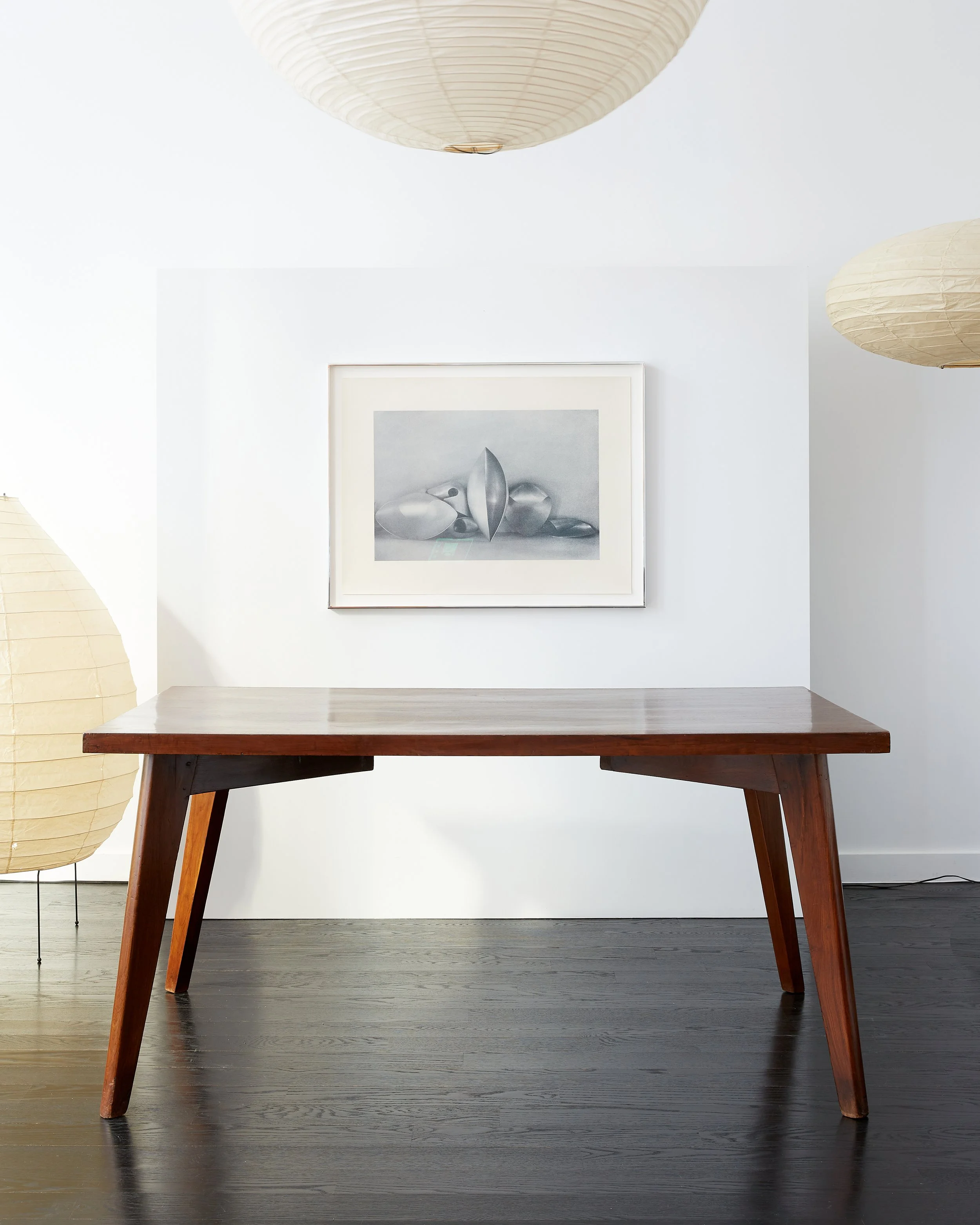
Pierre Jeanneret teak dining table/desk.
Chandigarh, India c. 1961.
Solid teak and teak veneer. Two pairs of slanted, tapered legs connected by two V-shaped crosspieces.
Conserved by Miguel Saco.
Measurements: 60” length, 36” depth, 29” height
Shipping + Delivery: Free local (NY) delivery. We also ship nationwide and worldwide. Please contact us for shipping or delivery costs. We work to obtain the most affordable shipping rates possible while ensuring that pieces are delivered safely.

Historic set of six Shaker dining chairs made by Lillian Barlow, Mount Lebanon, c. 1935.
Believed to be the last shaker chairs made (see image of letter from Lillian Barlow to Florence Roberts, wife of John S. Roberts, from the Winterthur Museum & Library, home to one of the most important Americana collections in the US. Sister Lillian Barlow died in 1942).
Last owned by Charles R. Muller, furniture scholar and co-author of “ The Shaker Chair”, first published in 1984.
Measurements: 41.5” Height (to top of finial) x 19” Width (at widest part) x 15.5” Depth x 17.75” Seat Height
Condition: Original, untouched condition. Beautiful honest wear with original varnish. Retains original cotton taped seats. Minor signs of wear consistent with age. Please refer to images and feel free to be in touch with any questions or for additional images.
Provenance: John S. Roberts collection, Shaker Farm, Canaan, New York, obtained from Shakers in 1930s; Christies, New York, October 21st, 1994; The Shaker Collection of Charles R. Muller, Canal Winchester, Ohio.

Dom Hans van der Laan chair for the Councilors’ Room, Raadhuis Budel.
The Netherlands c. 1962-66.
Ash, copper nails, black enameled steel legs.
One of twelve made.
Raadhuis Budel (Budel Town Hall) was designed in 1962 according to the principles of the Plastic Number by Dom Hans van der Laan. Jan de Jong was the architect for the project, which was completed in 1966. The building still exists however it was completely renovated in 1997. Much of the furniture was destroyed, though a few residents of Budel saved pieces from the containers they were removed in.
Dimensions: 24.25" width, 21.5" depth, 49.5" height, 19.25" seat height (without cushion)
About Dom Hans van der Laan (1904 - 1991):
Dutch Benedictine monk, architect, and leading figure of the Bossche School, Dom Hans van der Laan developed a new vision for architecture from within the confines of the monastery, completely uninfluenced by discussions in the world of architecture and design.
Not perceiving the golden ratio to be relevant to the field, van der Laan developed a theory of the ‘plastic number’, which he developed over decades by methodically studying the rhythms, rules and proportions found in nature. The mathematics of beauty.
Approached from a philosophical, theological and technological perspective, his architecture and furniture examines the primeval origin of architectural principles and the fundamental essence of the form. On both a theoretical and practical level, van der Laan sought to give significance and importance to simplicity. A voice to silence, a form to the void.
If van der Laan’s innovative work is characterized by an all embracing simplicity, numbers are the only decoration present. These numbers govern all formal choices and establish a relationship between the parts but, once used, disappear without a trace, leaving only the invisible harmony that permeates.
Additional information on the work of Dom Hans van der Laan can be found here.
Shipping + Delivery: Shipping costs are not included in the sale price as they vary greatly depending on location. Please contact us for shipping or delivery costs. Local (NY) delivery and pick-up is available, we also ship nationwide and worldwide. We work to obtain the most affordable shipping rates possible while ensuring that pieces are delivered safely.

Dom Hans van der Laan high chair from the boardroom at Raadhuis Budel.
The Netherlands c. 1962 - 66.
One of twelve made.
Ash, copper nails, black enameled steel legs.
Original leatherette seat
Raadhuis Budel (Budel Town Hall) was designed in 1962 according to the principles of the Plastic Number by Dom Hans van der Laan. Jan de Jong was the architect for the project, which was completed in 1966. The building still exists however it was completely renovated in 1997. Much of the furniture was destroyed, though a few residents of Budel saved pieces from the containers they were removed in.
Dimensions: 23.5” width, 23.5” depth, 49.75” height, 18.75” seat height
About Dom Hans van der Laan (1904 - 1991):
Dutch Benedictine monk, architect, and leading figure of the Bossche School, Dom Hans van der Laan developed a new vision for architecture from within the confines of the monastery, completely uninfluenced by discussions in the world of architecture and design.
Not perceiving the golden ratio to be relevant to the field, van der Laan developed a theory of the ‘plastic number’, which he developed over decades by methodically studying the rhythms, rules and proportions found in nature. The mathematics of beauty.
Approached from a philosophical, theological and technological perspective, his architecture and furniture examines the primeval origin of architectural principles and the fundamental essence of the form. On both a theoretical and practical level, van der Laan sought to give significance and importance to simplicity. A voice to silence, a form to the void.
If van der Laan’s innovative work is characterized by an all embracing simplicity, numbers are the only decoration present. These numbers govern all formal choices and establish a relationship between the parts but, once used, disappear without a trace, leaving only the invisible harmony that permeates.
Additional information on the work of Dom Hans van der Laan can be found here.
Shipping + Delivery: Shipping costs are not included in the sale price as they vary greatly depending on location. Please contact us for shipping or delivery costs. Local (NY) delivery and pick-up is available, we also ship nationwide and worldwide. We work to obtain the most affordable shipping rates possible while ensuring that pieces are delivered safely.

Pair of Pierre Jeanneret Teak and Iron Chairs. Model PJ-010510.
Chandigarh, India c. 1953 - 54.
Solid sculpted teak seat and backrest with 'Z'-type iron rod double leg assembly.
*Single chair also available, please inquiry directly.
Measurements: 18.5" width, 19" depth, 34.5" height, 17.5" seat height
Shipping + Delivery: Free local (NY) delivery. We also ship nationwide and worldwide. Please contact us for shipping or delivery costs. We work to obtain the most affordable shipping rates possible while ensuring that pieces are delivered safely.

SOLD.
Japanese silver leaf folding screen.
Late Edo period (1603 - 1868).
The beauty of this screen exists because it spent a large part of its life folded and stored away. The edges on each panel oxidized in a vignette that creates a repetition of silver moons.
Measurements: 69" height, 169.5" width (fully extended), 28 3/8" width (each individual panel)
Shipping + Delivery: Free local (NY) delivery. We also ship nationwide and worldwide. Please contact us for shipping or delivery costs. We work to obtain the most affordable shipping rates possible while ensuring that pieces are delivered safely.

SOLD.
Maria Pergay rectangular coffee table.
France, 1968.
Inox stainless steel over wood structure.
We've owned quite a few Pergay coffee tables and they really need to be seen in person to appreciate the beauty of their proportion and the flawless execution of a stainless inox steel skin.
Measurements: 46 5/16' width x 21 3/4" depth x 12" height
Shipping + Delivery: Free local (NY) delivery. We also ship nationwide and worldwide. Please contact us for shipping or delivery costs. We work to obtain the most affordable shipping rates possible while ensuring that pieces are delivered safely.

José Zanine Caldas carved wood side table, 1970s.
Produced by the Zanine workshop, Nova Viçosa, Bahia, Brazil.
One leg branded Zanine.
When Zanine Caldas returned to his home of Bahia, Brazil later on in his career, he became inspired by the local craftsmen who carved boats and furniture from felled trees. As such, he began experimenting with chiselling and carving large, sculptural pieces of furniture. A pioneer in the field of forest preservation and ecology, Caldas wrote extensively about his connection to the forest, and attempted to either use salvaged wood or to plant a new tree for each one he used in one of his projects. His work is a testament to the power of natural wood and its beauty as a material.
Provenance: Phillips: Property from a Private Collection, New York.
Measurements: 21" diameter, 16" height
Shipping + Delivery: Free local (NY) delivery. We also ship nationwide and worldwide. Please contact us for shipping or delivery costs. We work to obtain the most affordable shipping rates possible while ensuring that pieces are delivered safely.

ON HOLD.
Jean Prouvé Brise Soleil c. 1960's.
Designed in 1956, executed c. 1962-65 for Cité Scolaire de la Dullague, Béziers, France.
Aluminum.
Exceptionally good original condition. Wear associated with age, beautiful patina but no heavy dents to aluminum. Original chain mechanism inside the gold anodized aluminum frame, all runs smoothly.
Literature:
Peter Sulzer, Jean Prouvé: Œuvre complète / Complete Works, Volume 4: 1954-1984, Basel, 2005, pp. 133-34, fig. 1332.2s,1
Galeries Jousse Seguin and Galerie Enrico Navarra, Jean Prouvé, Paris, 1998, pp. 170-71
Dimensions: 74 1/4" height, 68 1/2" width, 3" depth when closed, 11 1/4" depth when open
Shipping + Delivery: Shipping costs are not included in the sale price as they vary greatly depending on location. Please contact us for shipping or delivery costs. Local (NY) delivery and pick-up is available, we also ship nationwide and worldwide. We work to obtain the most affordable shipping rates possible while ensuring that pieces are delivered safely.

Dom Hans van der Laan stools.
*Sold separately, one available.
The Netherlands c. 1970.
Pine, steel nails.
Acquired from a private catholic school in ‘s-Hertogenbosch, the Netherlands.
Dimensions: 18.75” width, 12.75” depth, 16.75” height
About Dom Hans van der Laan (1904 - 1991):
Dutch Benedictine monk, architect, and leading figure of the Bossche School, Dom Hans van der Laan developed a new vision for architecture from within the confines of the monastery, completely uninfluenced by discussions in the world of architecture and design.
Not perceiving the golden ratio to be relevant to the field, van der Laan developed a theory of the ‘plastic number’, which he developed over decades by methodically studying the rhythms, rules and proportions found in nature. The mathematics of beauty.
Approached from a philosophical, theological and technological perspective, his architecture and furniture examines the primeval origin of architectural principles and the fundamental essence of the form. On both a theoretical and practical level, van der Laan sought to give significance and importance to simplicity. A voice to silence, a form to the void.
If van der Laan’s innovative work is characterized by an all embracing simplicity, numbers are the only decoration present. These numbers govern all formal choices and establish a relationship between the parts but, once used, disappear without a trace, leaving only the invisible harmony that permeates.
Additional information on the work of Dom Hans van der Laan can be found here.
Shipping + Delivery: Shipping costs are not included in the sale price as they vary greatly depending on location. Please contact us for shipping or delivery costs. Local (NY) delivery and pick-up is available, we also ship nationwide and worldwide. We work to obtain the most affordable shipping rates possible while ensuring that pieces are delivered safely.
André Arbus three-panel folding screen.
Sycamore over plywood with solid sycamore edging and original brass hinges.
Designed for a private residence in Toulouse, France c. 1934.
Accompanied by a copy of original purchase invoice.
Original condition with slight wear consistent with age.
Measurements: Each panel measures: 63” height, 19.75” width, 1” depth. Total extended width: 59”.
Shipping + Delivery: Free local (NY) delivery. We also ship nationwide and worldwide. Please contact us for shipping or delivery costs. We work to obtain the most affordable shipping rates possible while ensuring that pieces are delivered safely.